Introduction
Whether you’re setting up a school laboratory, university research facility, hospital laboratory, industrial testing center, or quality control laboratory, having the right equipment is essential for achieving accurate and reliable results.
Modern laboratories rely on a combination of precision instruments, glassware, chemicals, and safety equipment to perform scientific experiments and analytical testing efficiently. Investing in high-quality laboratory equipment not only improves productivity but also enhances safety and accuracy.
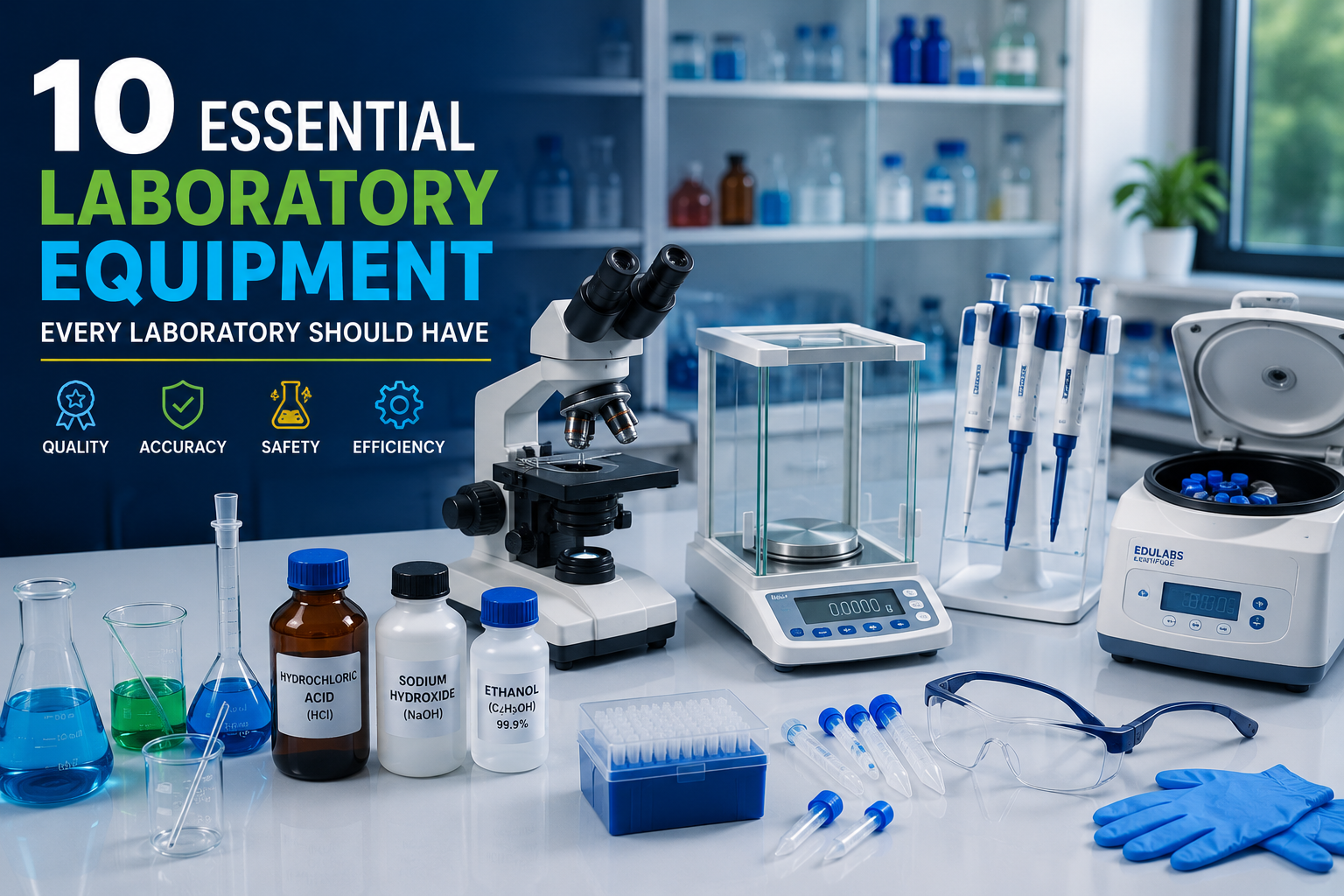
In this guide, we’ll explore ten of the most important laboratory equipment used in laboratories across education, healthcare, research, and industry.
1. Microscope
A microscope is one of the most fundamental laboratory instruments. It allows scientists, researchers, and students to observe microorganisms, cells, bacteria, and tiny structures invisible to the naked eye.
Common Uses
- Biological research
- Medical diagnosis
- Educational laboratories
- Quality control
2. Analytical Balance
An analytical balance is designed for highly accurate measurement of small quantities of chemicals and laboratory samples.
Benefits
- High precision
- Accurate weighing
- Reliable laboratory measurements
3. Laboratory Glassware
Laboratory glassware forms the backbone of scientific experiments.
Examples include:
- Beakers
- Conical Flasks
- Volumetric Flasks
- Measuring Cylinders
- Test Tubes
- Pipettes
- Funnels
Quality borosilicate glassware offers excellent chemical resistance and durability.
4. Laboratory Chemicals
Laboratory chemicals are essential for conducting experiments, research, testing, and analysis.
Examples include:
- Hydrochloric Acid
- Sodium Hydroxide
- Sulfuric Acid
- Ethanol
- Acetone
- Buffer Solutions
- Indicators
5. Micropipettes
Micropipettes are precision instruments used to transfer extremely small volumes of liquids accurately.
Applications include:
- Molecular Biology
- Medical Laboratories
- Pharmaceutical Research
- Chemical Analysis
6. Centrifuge
Centrifuges separate substances based on density using high-speed rotation.
Widely used in:
- Clinical laboratories
- Research institutions
- Blood testing
- Biotechnology
7. pH Meter
A pH meter measures the acidity or alkalinity of liquids.
Industries using pH meters include:
- Water treatment
- Food testing
- Agriculture
- Chemical laboratories
8. Hot Plate & Magnetic Stirrer
These instruments are used to heat and mix chemical solutions safely and efficiently.
Benefits:
- Uniform heating
- Consistent mixing
- Better experimental results
9. Laboratory Plasticware
Plastic laboratory products are lightweight, durable, and suitable for many routine laboratory applications.
Examples include:
- Pipette Tips
- Centrifuge Tubes
- Sample Containers
- Wash Bottles
- Storage Bottles
10. Safety Equipment
Laboratory safety should always be the highest priority.
Essential safety equipment includes:
- Laboratory Coats
- Safety Goggles
- Nitrile Gloves
- Face Shields
- Spill Kits
- Fire Extinguishers
Why Choosing Quality Laboratory Equipment Matters
Using high-quality laboratory equipment offers several advantages:
- Improved accuracy
- Increased reliability
- Better safety
- Longer equipment lifespan
- Consistent experimental results
- Reduced maintenance costs
Whether you operate a school laboratory, research institute, healthcare facility, or industrial laboratory, investing in reliable laboratory equipment is essential for achieving professional results.
Conclusion
Every successful laboratory depends on reliable equipment, quality chemicals, durable glassware, and safe laboratory practices. By selecting the right laboratory products, organizations can improve efficiency, ensure accurate testing, and support scientific innovation.
At Edulabs Enterprises Limited, we are committed to supplying high-quality laboratory solutions for educational institutions, healthcare facilities, research organizations, industrial laboratories, and scientific professionals across Tanzania.